Delhi HC’s Aman Gupta Ruling Expands Personality Rights to Entrepreneurs
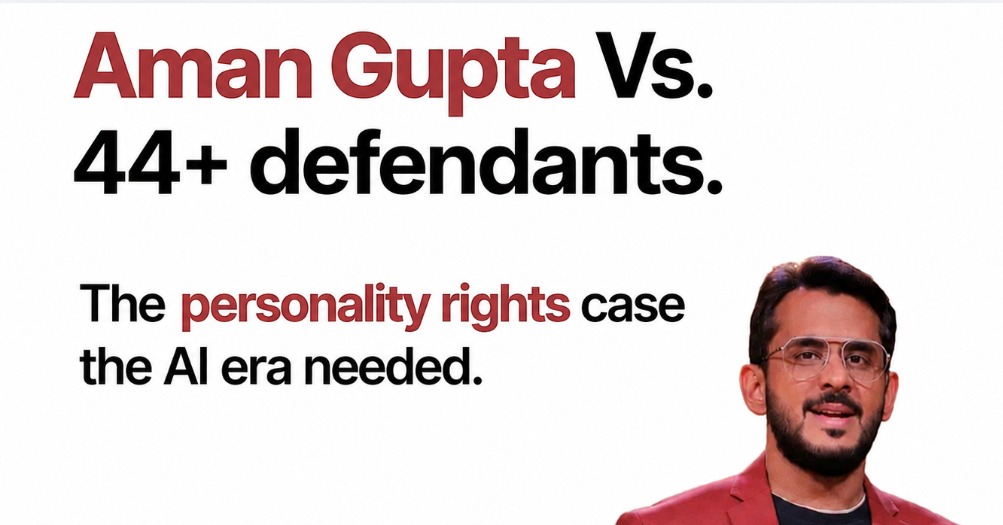
Justice Tushar Rao Gedela’s interim order of 7 May 2026 in Aman Gupta v. John Doe & Ors. opens a door that had remained closed in Indian personality rights jurisprudence. The plaintiff is neither a film star nor an athlete. He is a business founder who built his profile through brand building and a reality television seat. The Delhi High Court found this sufficient basis to grant him the same protective umbrella previously extended to Bollywood actors, cricketers, and spiritual leaders.
The Reliefs Granted
The single judge issued an ex parte ad interim injunction against more than 44 defendants, including the customary John Doe parties whose identities remain unknown. Defendants 1, and 6 to 45 stand restrained from using Gupta’s name, image, voice, likeness, photographs, videos, GIFs, contact details, or “any aspect of the plaintiff’s persona” without his express written authorisation. The order expressly covers AI, deepfake technology, and any other medium of infringement.
Senior Advocate Diya Kapur, appearing for Gupta with a junior team, laid out a fairly grim record before the bench. Fake endorsements. Counterfeit merchandise. AI-generated impersonations. Sexually explicit deepfakes. Instagram accounts impersonating Gupta. His purported contact details circulating online. The court singled out the sexually explicit content for separate observation, recording that the motive behind such material could only be unlawful financial gain and unjust enrichment.
Google and Meta received specific takedown directions and were ordered to disclose details of the offending accounts to the plaintiff. This combination of takedown plus disclosure has become routine in Indian personality rights litigation. Its scope here is unusually wide.
The Doctrinal Backdrop
India still lacks a codified law on personality rights. Courts have stitched together protection from several sources: the right to privacy and dignity under Article 21 (read into the Constitution by K.S. Puttaswamy v. Union of India, 2017), trademark protection under the Trade Marks Act 1999, the tort of passing off, and copyright principles concerning performers’ rights.
The Delhi High Court’s Titan Industries Ltd. v. Ramkumar Jewellers (2012) defined the right of publicity as the right to control commercial use of human identity. The much-cited Anil Kapoor v. Simply Life India (2023) widened the scope considerably, holding that voice, gestures, mannerisms, and catchphrases also fall within the protective ambit. The Bombay High Court extended similar protection to playback singer Asha Bhosle against AI voice cloning, treating the singer’s voice as a proprietary attribute capable of being misappropriated.
Justice Gedela’s observations about Gupta echo this lineage. The judge recorded that Gupta had achieved milestones in a “short span of his career,” establishing himself firmly in India’s business circles whilst gaining significant international exposure. The finding goes directly to a threshold question in publicity rights: does the plaintiff possess the kind of commercial identity that warrants legal protection? Earlier cases worked through this for actors and sportspeople. The Gupta order applies the same test to entrepreneurs with sufficient public visibility, and there is no obvious doctrinal reason it should stop there.
Why the AI Angle Is Doing Real Work
While India’s regulatory framework, including strict intermediary compliance windows under the Information Technology Rules, mandates the rapid takedown of non-consensual sexually explicit content and synthetic media, these rules primarily govern platform liability rather than creating individual intellectual property.
Gupta brilliantly pulls these regulatory compliance threads into a traditional common-law personality rights claim. By establishing a violation of his core persona first, he activates the statutory mechanisms that force intermediaries to act.
Justice Gedela’s framing acknowledges that the doctrinal question of whether deepfakes are best categorised as personality rights violations remains unsettled. He side-stepped a conclusive ruling by recognising that the motive behind sexually explicit deepfakes is commercial exploitation, which falls within the existing publicity rights framework. Whatever one thinks of the doctrinal neatness here, the Court got to the right place: urgent interim relief against material that should never have been made.
What This Means for Practitioners
Three things stand out for those advising public figures, brand owners, or platform counsel.
The threshold has effectively expanded. A founder, executive, investor, or content creator with significant brand value can credibly seek the same dynamic injunctive relief that Bollywood plaintiffs have obtained for the better part of two decades. The reasoning travels well.
Dynamic injunctions covering future infringements remain the preferred remedy. Courts are alive to the cat-and-mouse problem of static cease-and-desist orders against fast-moving online infringement. Drafting prayer clauses that anticipate this is now table stakes.
Intermediary cooperation is being sought as part of the relief package, going beyond ordinary takedown. Counsel for Google reportedly submitted at the hearing that some content, including memes and harmless material, might be difficult to remove wholesale. The court accepted this nuance, clarifying that not every post would require removal. Sensible. Otherwise, the order risks becoming a censorship instrument rather than a proportionate remedy.
The matter goes before the Joint Registrar on 3 August 2026 for completion of pleadings, and before the bench on 1 October 2026 for further hearing. Whether the interim relief crystallises into a final decree, and on what terms, will offer further guidance on how Indian courts handle personality rights for the new class of digital-era public figures.
The doctrinal architecture remains untidy. A codified statute would help. Until that arrives, judges are quietly building the law one ad interim order at a time.